
Blind Corner Cabinets: Solutions to a Common Kitchen Storage Issue
A blind corner cabinet is created when one cabinet extends into a corner, leaving a portion of the storage area hidden behind an adjacent cabinet. The result is a deep storage space that on its own is not very useful particularly when it's door is small. Retrieving those items can be frustrating because the space is so awkward to reach.
Here are some solutions to improve the situation. Keep in mind, each require a minimum door width. If your corner cabinet doesn't have it, the solution may require some more aggressive renovation.
LeMans II Corner Units
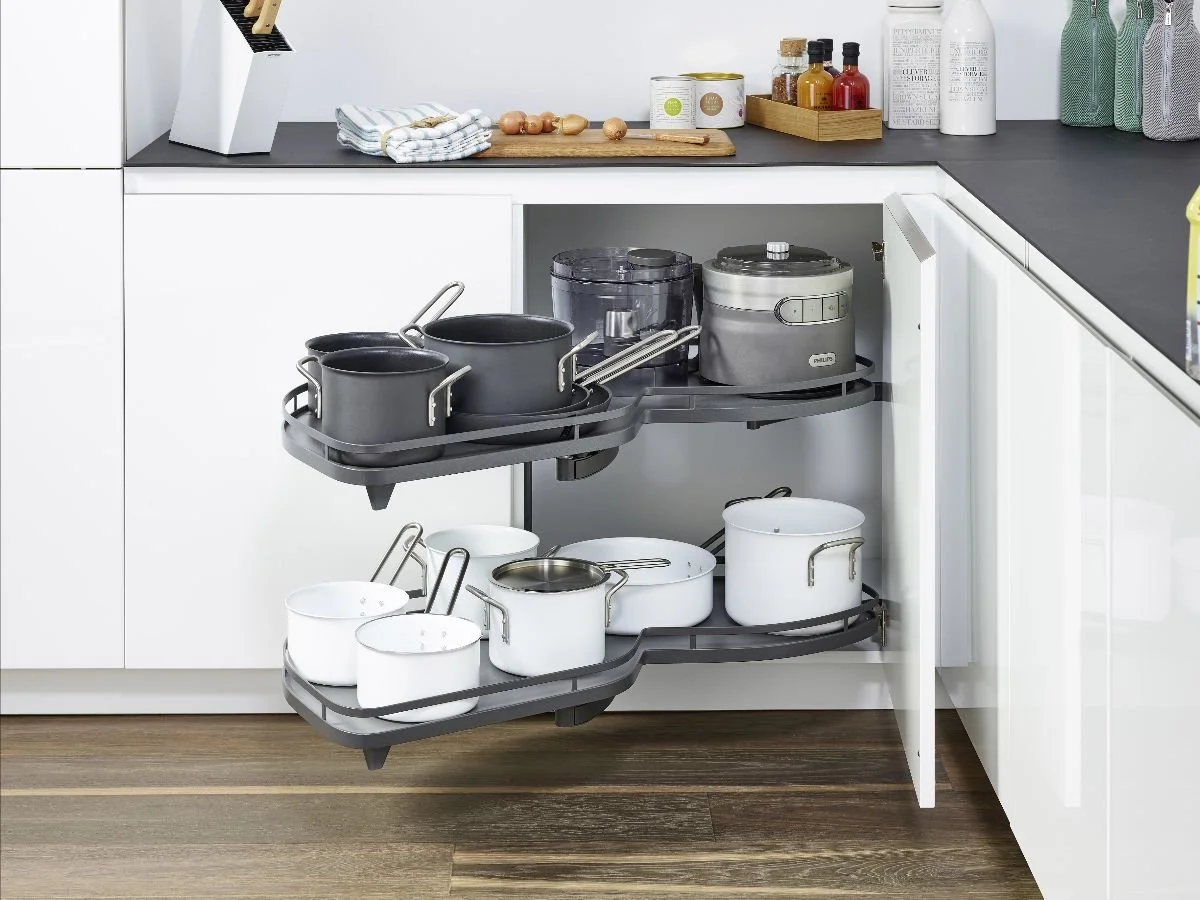
One of the most popular blind corner cabinet organizers is the LeMans II system. Named for its distinctive curved shelf design, the LeMans II features shelves that swing completely out of the cabinet, bringing stored items into easy reach. Each shelf operates independently, allowing homeowners to access items without unloading the entire cabinet. The smooth operation and excellent accessibility have made the LeMans II a favorite among kitchen designers and homeowners alike.
Today's LeMans II systems are available in four different sizes. Large units require larger door openings. (Note door openings are not the same as door sizes.) Specifications also differ between framed and frameless cabinetry, as well as left-hand and right-hand blind corner configurations.
The LeMans II is available in multiple finishes, allowing it to coordinate with a variety of cabinet hardware and kitchen styles.
Magic Corner Systems
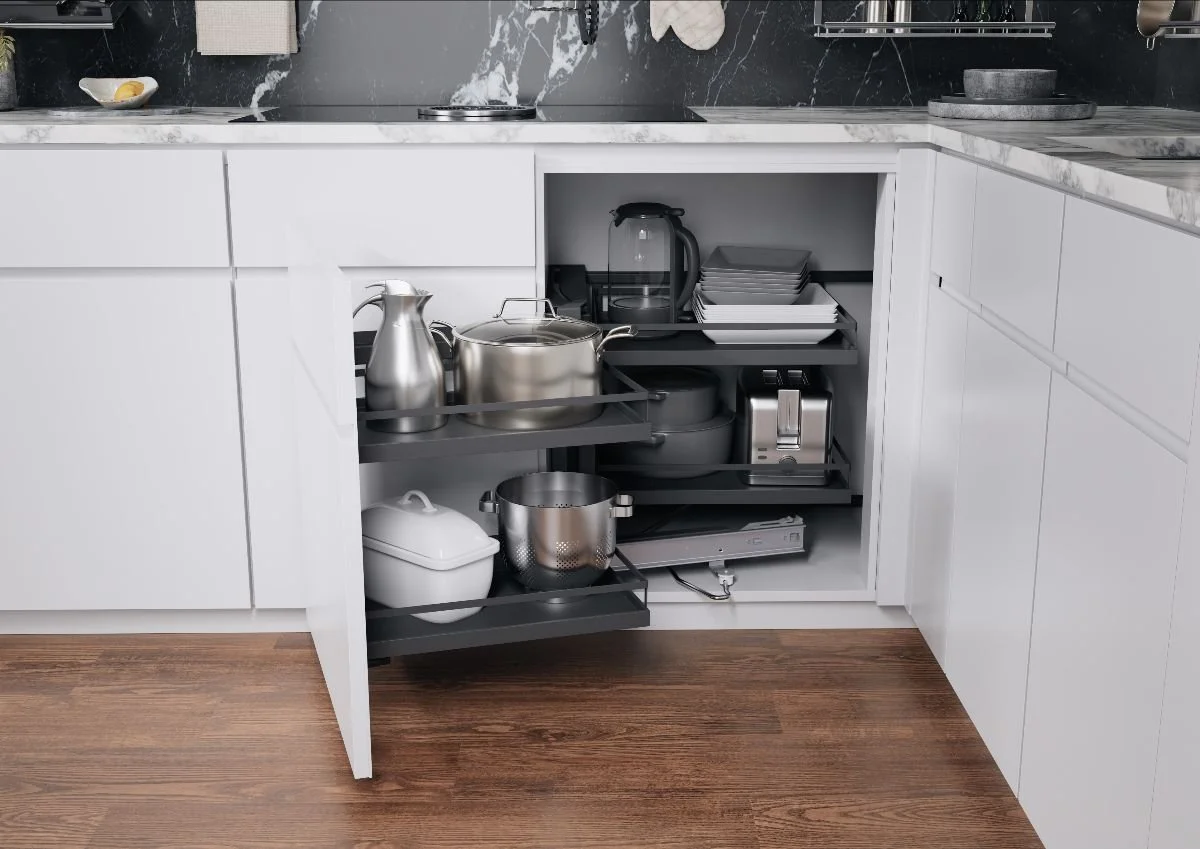
The Magic Corner system is another highly effective solution for blind corner storage. The Magic Corner uses a sophisticated mechanism that pulls the hidden rear baskets into view when the door is opened. This design provides better storage than the LeMans II but requires a larger opening. The Magic Corner systems are more expensive but if storage space counts, Magic Corner Systems are a good choice.
Magic Corner I vs. Magic Corner II
Magic Corner systems are available in two primary configurations: Magic Corner I and Magic Corner II.
The primary difference is how the front baskets are mounted. In the Magic Corner I system, the front baskets are attached directly to the cabinet door. Opening the door automatically pulls the storage baskets outward.
The operation is simpler and the unit usually costs less though it may put stress on the cabinet door.
The Magic Corner II system is independent of the cabinet door and therefore does not put stress on it. Once the door is open the user pulls the storage mechanism out. Generally, this version operates more smoothly than Magic corner I.
Take a look at the Magic Corner I and Magic Corner II systems in action.
In retrofit projects, the direction of the cabinet door swing affects which Magic Corner system can be installed. While both systems are excellent solutions, many designers prefer Magic Corner II because it reduces wear on cabinet doors and typically operates more smoothly over time.
Replacing a Blind Corner with a Lazy Susan
None of these systems will work with a cabinet door that's 9 to 12 inches wide, though it's often possible to create the room with creative designing and substituting some cabinetry. The blind corner and at least one adjacent cabinet will be substituted out. Nine to twelve inches are needed on each side of the corner to fit a Lazy Susan corner cabinet.
A Lazy Susan is extremely efficient as a storage solution but it only uses about 70 percent of the corner cabinet's space. When long term storage is the goal, clients who choose to unpack the cabinet manually, may put in a corner cabinet only for the improved access opting not to install the Lazy Susan.
The change from a blind corner cabinet to a corner cabinet nearly always requires the removal and replacement of the countertop.
The Bottom Line
Whether you choose a LeMans II system, a Magic Corner organizer, or Lazy Susan corner cabinet, addressing blind corner storage during a kitchen remodel can significantly improve the functionality and organization of your kitchen for years to come.